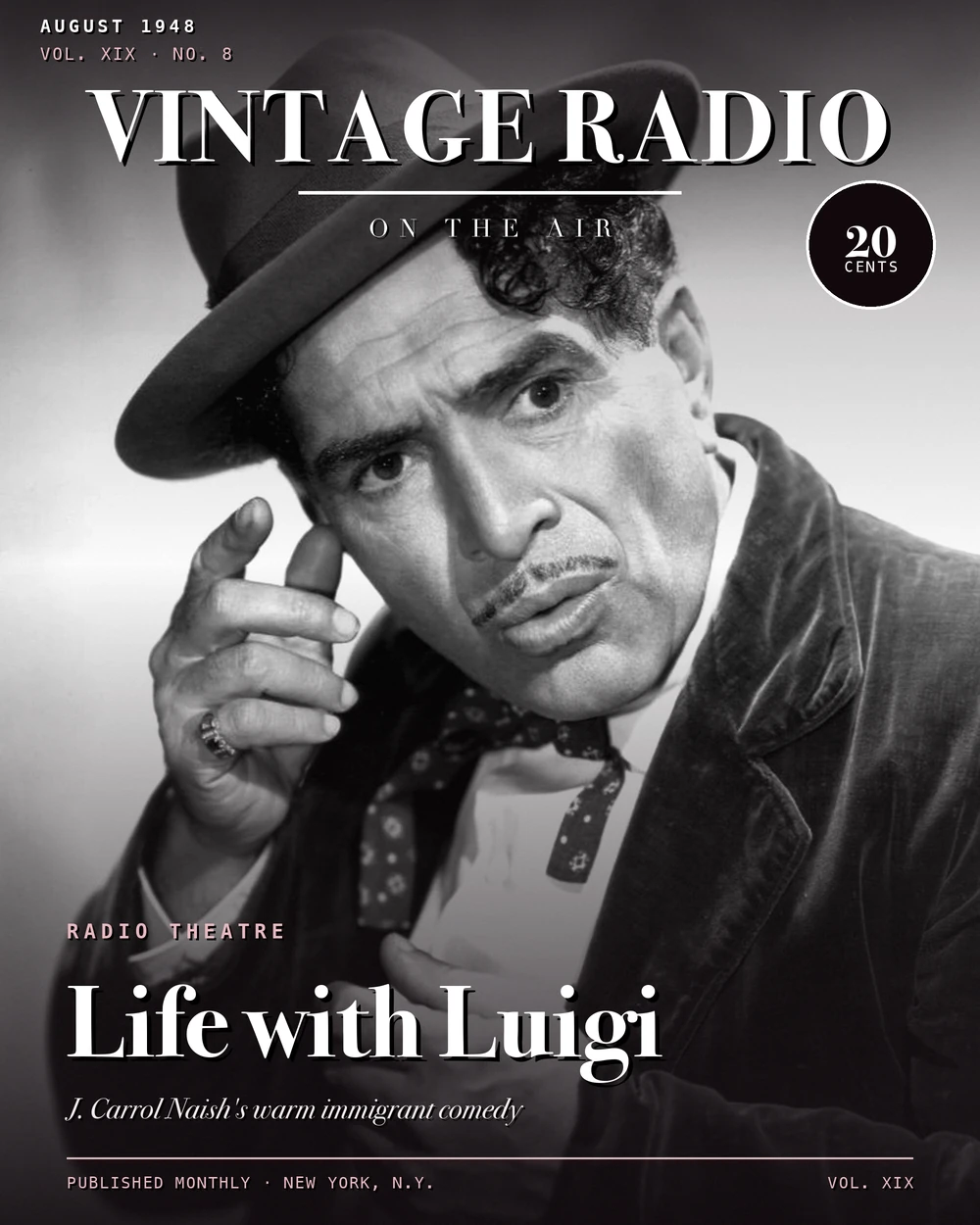
Life With Luigi
The Show That Took On Bob Hope
When Life With Luigi premiered on CBS on September 21, 1948, it was placed in a competitive slot that would have buried most new programs. Within a year it had pulled even with Bob Hope's show in the ratings. By May 1950, it had done something most radio observers considered impossible: it beat Hope outright, 10.5 to 9.3 in the monthly Nielsen numbers. The following month the two shows tied at 7.7, and Lever Brothers then cancelled its twelve-year sponsorship of Bob Hope's Tuesday night program. That's the kind of dent Life With Luigi made in the landscape of early 1950s radio comedy.
The show was created by Cy Howard, born Seymour Horowitz in Milwaukee in 1915. Before Luigi, Howard had been writing jokes for Danny Thomas, Jack Benny, Milton Berle, and Bert Lahr, and briefly worked as a salesman in Chicago earning $70 a week. He came to CBS as a producer and ended up creating two of radio's most popular shows at the same time — Life With Luigi and My Friend Irma, both on the same network. By October 7, 1952, Howard's two shows occupied back-to-back Tuesday timeslots at 9:00 and 9:30 p.m., competing head-on against the Martin and Lewis Show and Fibber McGee and Molly on NBC. For the 1952 season, Luigi finished eighth overall with a 7.7 average rating, while the Martin and Lewis Show came in 27th with a 5.9.
Howard had originally envisioned the program as something closer to drama than comedy. He brought in writer Hy Kraft to develop scripts from his general ideas, and the show launched at a production cost of $6,500 per week — less than half what Wrigley's was paying for Gene Autry's Melody Ranch on the same network. The show had been announced under the title The Little Immigrant and was renamed just before the first broadcast. General Foods had expressed interest early in development, but that deal never materialized. The show ran with a 30% audience share before Wrigley's Gum came on as sponsor with the January 10, 1950 broadcast, an episode titled "Luigi's First Citizenship Papers." Wrigley's stayed through the end of the radio run in 1953.
Luigi Basco and the World He Lived In
The premise was a classic immigrant story built around comic friction. Luigi Basco, a shy, sweet-natured young man who had grown up on the outskirts of Rome, came to Chicago to open an antique store. He rented space at 21 North Halsted Street in the Little Italy neighborhood, right next door to Pasquale's Spaghetti Palace at number 19. His central aspiration was to become an American citizen, and he attended night school to study citizenship and government alongside other newcomers — Schultz, a perpetually complaining German whose rheumatism was always killing him, and classmates named Horowitz and Olsen. Miss Spaulding taught the class.
The structural engine of the show was Pasquale, Luigi's American sponsor. It turned out Pasquale had paid Luigi's boat fare specifically hoping to marry off his daughter Rosa to the impressionable young immigrant. Rosa had a 300-pound frame, a squeaky voice, and what one account described as the loudest fat-girl laugh in all of radio, ending in a meek "Hello, Luigi." Pasquale was characterized as a lying, conniving plotter and a heartless saboteur of Luigi's love life — whenever Luigi's romantic hopes were dashed by the end of an episode, Pasquale was conveniently on hand. His recurring summons ran: "Just so happen I'm-a bring-a my little baby with-a me. I'm-a gonna call er over... Oh, Rooosssa! ... Rooosssa! ... ROSA!!" To which Rosa would answer: "You call me, Papa?" And Pasquale would say: "Say allo to Luigi."
Each episode was framed as a letter home. Luigi opened with "Dear-a Mamma-mia" and closed with "So long-a, Mamma-mia. Your lovin-a son-a, Luigi Basco, the li'l immigrant." The theme music was "Chicago" played by the full orchestra, blending into an Italian-sounding "Oh, Marie" on accordion — that accordion played softly throughout each episode and came up again for the closing. The show was sometimes described as the Italian counterpart to The Goldbergs, which had been chronicling Jewish immigrant experience in New York for years.
Variety reviewed the premiere the week after it aired, calling it "a pleasant, serio-comic flavor that is likely to deepen with familiarity," though warning that Howard would need firm control to keep it from sliding into pure dialect gaggery.
The Cast Behind the Characters
J. Carrol Naish, who played Luigi, was Irish. His full name was Joseph Patrick Carrol Naish, born January 21, 1896, in New York City, with ancestors from County Limerick listed in Burke's Peerage. His surname was pronounced "Nash." Over a film career that accumulated more than 200 credits during the Golden Age of Hollywood, Naish earned the nickname "Hollywood's one-man U.N." for his ability to portray characters of dozens of nationalities — Southern European, Eastern European, Latin American, American Indian, Middle Eastern, South Asian, East Asian, Pacific Islander — while rarely playing Irish roles. He received two Academy Award nominations for Best Supporting Actor, first for Sahara (1943), in which he played an Italian prisoner of war named Giuseppe, and second for A Medal for Benny (1945), for which he won the Golden Globe Award for Best Supporting Actor. He was honored with a star on the Hollywood Walk of Fame in 1960.
His years playing Luigi on radio and later television typecast him as Italian, which eventually became a professional constraint. According to Hedda Hopper's newspaper column of March 19, 1953, Naish said he would not return to the show unless sponsors allowed him to tape it, since live broadcasts had prevented him from accepting film roles that required long location trips. After Luigi, he played the title role in the syndicated television series The New Adventures of Charlie Chan from 1957 to 1958, and in 1955 originated the role of Alfieri in the one-act verse version of Arthur Miller's A View from the Bridge on Broadway. In 1971 he came out of retirement to star in Dracula vs. Frankenstein, the final film for both him and co-star Lon Chaney Jr. He died of emphysema on January 24, 1973.
Alan Reed, who played Pasquale, was born Herbert Theodore Bergman in New York City on August 20, 1907, to Jewish parents of Lithuanian and Ukrainian descent. He had adopted the stage name Alan Reed in 1939 specifically to avoid being typecast in ethnic parts, having earlier performed as Teddy Bergman. Before Luigi, Reed was well known as the poet Falstaff Openshaw on The Fred Allen Show, had his own five-minute ABC program called Falstaff's Fables, and had played Solomon Levy on Abie's Irish Rose and Chester Riley's boss on The Life of Riley. He later voiced Boris the Russian Wolfhound in Disney's Lady and the Tramp (1955), played Pancho Villa in Viva Zapata! (1952) opposite Marlon Brando, and voiced Fred Flintstone for the entire six-season run of The Flintstones from 1960 to 1966 — reportedly improvising the catchphrase "Yabba dabba doo!" from a script that had simply called for Fred to say "Yahoo!" Reed died of a heart attack in Los Angeles on June 14, 1977, and his body was donated to medical research.
Hans Conried, who played Schultz, had been a member of Orson Welles' Mercury Theatre Company before beginning professional radio work in 1937, and studied acting at Columbia University. After Luigi, he became best known for voicing Captain Hook and George Darling in Walt Disney's Peter Pan (1953) and Snidely Whiplash in the Dudley Do-Right cartoons. He also played Professor Kropotkin on My Friend Irma, the companion Cy Howard show on CBS. Born Hans Georg Conried Jr. in Baltimore, Maryland, on April 15, 1917, he died January 5, 1982.
Guest Stars and the Television Move
Notable guests during the radio run included Frank Sinatra and Mario Lanza. Lanza appeared in November 1949 in a scene set in a record store. Sinatra's appearance, in an episode titled "A Day in New York with Frank Sinatra" on October 10, 1950, was a coordinated event — the entire Luigi cast was flown to New York City for the recording, and in return Naish and key supporting cast appeared on Sinatra's Saturday night CBS television show as a preview of the planned TV version of Luigi.
The CBS television version premiered September 22, 1952, originating at KNXT in Hollywood and scheduled immediately following I Love Lucy, the network's top-rated program. General Foods — which had passed on sponsoring the radio show years earlier — came on as television sponsor at $25,500 per episode under the Instant Maxwell House Coffee brand. Naish, Reed, Jody Gilbert, and Mary Shipp all reprised their radio roles; Hans Conried did not return for television. The first episode was titled "Citizenship." The TV show drew a 38.5 rating and finished 13th for the season, but was cancelled after pressure from activist groups who claimed it depicted Italian-born Americans disparagingly. Its final episode aired December 22, 1952.
CBS attempted a revamped version in spring 1953. Vito Scotti replaced Naish as Luigi, Thomas Gomez replaced Reed as Pasquale, and Muriel Landers replaced Gilbert as Rosa; Mary Shipp stayed on as Miss Spaulding. In the new version, Luigi was reimagined as a waiter for Pasquale rather than the owner of his own antique shop — a change that stripped the character of his independence. CBS executive Harry Ackerman commented on Scotti's performance: "Luigi finally is what he's supposed to be — a sensitive Italian and not a push-cart peddler." The revamped version aired Thursdays at 8 p.m. from approximately April 9 through June 4, 1953, and was cancelled by that summer.
How It Ended
The radio version ended abruptly in early 1953, likely after either the March 17 or March 24 broadcast, and went off without fanfare. The circumstances combined several pressures at once. Writer and director Mac Benoff had appeared before the House Un-American Activities Committee on accusations of Communist affiliations, casting a shadow over the production. At the same time, broader scrutiny of programs seen as perpetuating ethnic stereotypes was intensifying, which the television cancellation had already made visible. And Naish himself had lost interest in continuing the role, a dissatisfaction that Hopper's March 1953 column had already made public. A few test episodes were recorded in May 1954 to explore converting Luigi into a fifteen-minute daily radio strip, but nothing came of it.
Cy Howard left CBS in 1953 after the network demanded exclusive rights to his work in exchange for a contract paying him more than a million dollars. He later won a Primetime Emmy Award for outstanding writing on The Smothers Brothers Comedy Hour. His papers, including scripts, production files, and correspondence from both his radio and television years, are preserved at the Wisconsin Historical Society.